When you’re buying a home with young children, it’s very easy to shop for the life you have right now.
A spare bedroom becomes the nursery. The small garden seems enormous to a toddler. Being twenty minutes from school doesn’t sound too bad when you’re still thinking in terms of pram walks and nursery drop-offs. But children have an inconvenient habit of growing.
Suddenly, that perfectly adequate home needs to accommodate bigger beds, mountains of sports equipment, homework, friends coming over and teenagers who would quite like to be able to get around without relying on Mum and Dad’s taxi service.
So, if you’re hoping your next move will last for more than a few years, it pays to think beyond what your family needs today. Here are some of the things worth considering when searching for a home your children can genuinely grow into.

1. Look beyond the nearest primary school
Schools understandably sit near the top of the list for many family buyers, but don’t focus solely on where your children will go next.
If you’re planning to stay for the long term, research both primary and secondary options, admissions criteria and catchment areas. Remember that being relatively close to a school doesn’t necessarily guarantee a place, and catchments can change from year to year.
It’s also worth thinking practically about the school run itself. Could you walk or cycle? Is public transport straightforward? What would the journey look like during rush hour?
A ten-minute drive on a quiet Sunday afternoon can look very different at 8:15am on a Tuesday.
2. Visit the street at different times of the day
A quiet residential road at 11am can become a very different place during rush hour.
Before committing, try visiting the property in the morning, after school and during the evening. Listen to the traffic, see how busy the pavements become and get a feel for how the neighbourhood actually functions.
If the property is close to a main road, it may also be worth researching local air pollution levels. For families with children walking or cycling regularly, traffic volume and air quality can be just as relevant as the distance to the nearest park.
Likewise, look at local crime information and spend some time walking around the neighbourhood rather than assessing everything from the car. Statistics are useful, but experiencing an area yourself can tell you a lot about whether you’ll feel comfortable living there.
3. Think about how children will get around without you
When children are tiny, proximity to the things you use matters most. As they grow, their independence starts to matter too.
Being able to walk safely to school, cycle to a friend’s house or catch a bus to an activity can have a huge impact on family life later on. Look at public transport, cycle routes and how easy it is to reach the places older children and teenagers are likely to use.
This is one reason areas such as Finsbury Park can work particularly well for families. Alongside green space and local amenities, the area benefits from extensive Underground, rail and bus connections, making independent travel considerably easier as children get older.
Your future self may be very grateful you considered this before signing up for another decade of lifts.
4. Don’t underestimate storage
Babies are small. Their belongings are not. Unfortunately, the amount of stuff doesn’t necessarily decrease as they get older. Pushchairs and travel cots eventually make way for scooters, bikes, football kits, musical instruments, school bags and seemingly endless collections of shoes.
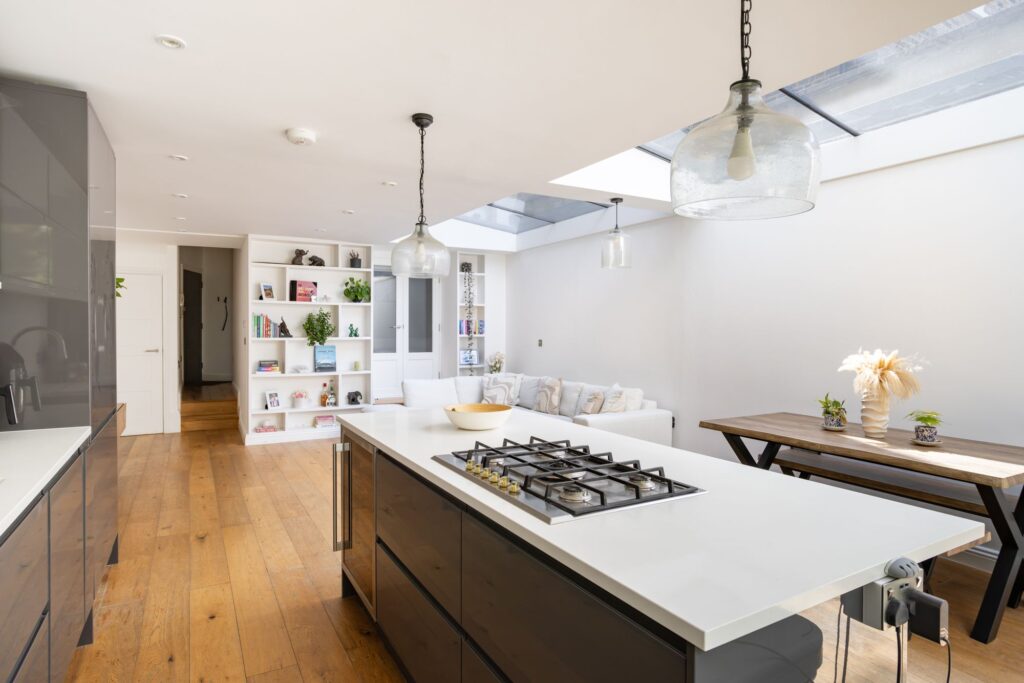
When viewing properties, look beyond the number of bedrooms and think seriously about where everyday family life will actually go. Is there somewhere for coats and shoes by the front door? Could bikes be stored securely? Is there loft or cellar space? Are there useful built-in cupboards?
A slightly smaller home with excellent storage can sometimes work far better for family life than a larger property where everything ends up permanently underfoot.
5. Look at the layout, not just the square footage
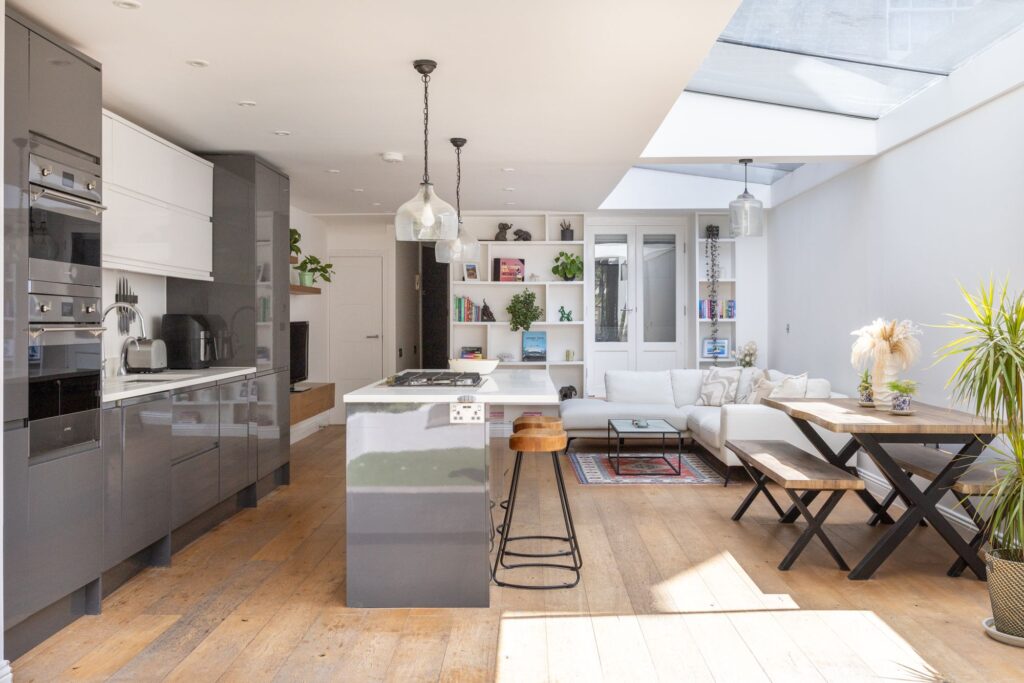
A property’s floor area only tells you so much. How that space is arranged can be much more important. An open-plan kitchen overlooking the garden might be brilliant when children are small and you want to keep an eye on them while cooking. A second reception room that initially becomes a playroom could later turn into a homework space, snug or teenage den.
Think about where everyone will spend their time as your children get older. Will there eventually be somewhere for adults and children to have a little separation? Could bedrooms accommodate desks as well as beds?
The best family homes aren’t necessarily enormous. They’re adaptable.
6. Scope out the local family life
A family-friendly neighbourhood involves far more than having a good school nearby.
Look for parks, playgrounds, libraries, swimming pools and sports facilities. Are there children’s classes, football clubs, dance schools or after-school activities within easy reach? And as your children get older, are there cafés, shops and community spaces they’ll eventually be able to reach themselves?
It’s something North London does particularly well. Areas including Finsbury Park, Stroud Green and Crouch End combine green space and family amenities with the advantages of being well connected to the rest of London.
These things can seem secondary when you’re standing inside a beautiful kitchen, but they’re often what determines how much you actually enjoy living somewhere.
7. Consider your commute – and everyone else’s
It’s easy to judge a location based entirely on the commute to work. For a family, there can eventually be several different commutes happening at once.
There’s work, school, childcare, clubs, friends and weekend activities to consider. A property that adds twenty minutes to every journey can quickly become exhausting once you’re making those trips multiple times a day.
Think about the entire family’s routine rather than one journey into the office. Sometimes paying a little more for a well-connected location, or compromising slightly on the property itself, can make everyday family life significantly easier.
8. Ask yourself: can this house change with us?
Perhaps the biggest question is whether the property has room to evolve.
Could you extend into the loft one day? Is there potential for a side return or rear extension, subject to the necessary permissions? Could an existing room change purpose as family life evolves?
You don’t necessarily need to carry out those projects immediately. The important thing is having options. A playroom can become a study. A home office might eventually become another bedroom. A loft could provide the extra space that prevents you needing to move again when your children become teenagers.
Of course, never assume you’ll automatically be able to extend. Planning restrictions, conservation areas, leasehold arrangements and the building itself can all affect what’s possible, so investigate properly before basing your purchase on future works.
Buy for real life, not just the viewing
There’s no such thing as a completely future-proof home. Families change, jobs move and life has a habit of ignoring even the best-laid plans.
But thinking a few years ahead can help you choose a property that gives your family room to change without immediately needing another move.
Schools matter. So does storage. Parks matter. So does the 7:45am traffic outside the front door. The trick is looking beyond how a home feels during a 20-minute viewing and imagining what an ordinary Wednesday might look like there five years from now.
The best family home isn’t necessarily the one that ticks every box today. It’s the one that still works when those little people suddenly aren’t quite so little anymore.
Contact us:
mark@daviesdavies.co.uk – Sales Director (contact for sales, lettings and new homes)
katrina@daviesdavies.co.uk – Director of Property & Block Management (contact for property and block management)
Davies & Davies Estate Agents, 85 Stroud Green Road, London, N4 3EG
Article & images by Barefaced Studios
You might also want to read other useful blog articles by clicking here.
Please note that all content contained within our website is for informational purposes only. You should not construe any such information or other material as legal, tax, investment, financial, or other advice. All Content on this site is information of a general nature and does not address the circumstances of any particular individual or entity. We advise seeking professional advice from a legal, financial, or other professional.
When you’re buying a home with young children, it’s very easy to shop for the life you have right now.
A spare bedroom becomes the nursery. The small garden seems enormous to a toddler. Being twenty minutes from school doesn’t sound too bad when you’re still thinking in terms of pram walks and nursery drop-offs. But children have an inconvenient habit of growing.
Selling your first home is an exciting milestone, but if you’ve never done it before, it can also feel like stepping into the unknown.
You know you need an estate agent, a solicitor and a buyer, but what actually happens before your property goes on the market? How do you know what your home is worth? What documents will you need? And how do you choose an estate agent that’s right for you? The good news is that a little preparation at the start can make the whole process far smoother. From understanding your finances to gathering important paperwork, here’s everything worth getting organised before you put the ‘For Sale’ board up.

There’s nothing quite like having an offer accepted on a home that ticks all the right boxes. After weeks, or even months, of searching, everything suddenly starts to feel real. Then the waiting begins.
Buying a property rarely happens quickly. Mortgage applications, surveys, solicitors and property chains all play a part, and while you can’t control every stage of the process, you can influence more than you might think. Over the years, we’ve seen organised buyers keep their purchases moving from day one, while small oversights have added unnecessary delays to others. A little preparation can make a significant difference.
Get in Touch
Opening Times
Mon – Thurs: 0900 – 1815
Fri: 0900 – 1800
Sat: 1000 – 1600
Sun: Appointments by request